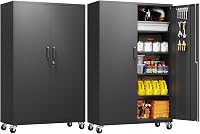
Rolling vs Stationary Garage Cabinets: Which Is Better? (November 2026)
Choose a rolling garage storage cabinet when moving the whole cabinet solves a work or access problem. Choose a stationary cabinet for a permanent storage zone, and check floor space, shelf loads and anchoring needs before buying either type.
On this page (9 sections)
- Rolling garage storage cabinet vs stationary: which fits your routine?
- Which of these cabinets suits your tools and space?
- How much space does a cabinet need beyond its footprint?
- How should you compare shelf capacity and usable storage?
- What setup should you complete before loading either cabinet?
- Do rolling and stationary cabinets need wall anchoring?
- How should you move and care for a rolling cabinet?
- Which organization mistakes waste cabinet space?
- Which garage cabinet should you choose?
Choose a rolling garage storage cabinet when moving the entire cabinet solves a work or access problem; choose a stationary cabinet when your supplies belong in one permanent spot. Wheels earn their space only if you have a safe route and somewhere useful to move the cabinet.
For these picks, Yizosh suits bulky tool storage, Letaya suits a fixed storage wall, and Greenvelly suits changing layouts with tighter floor space. Start with your routine, then check dimensions, load limits and setup needs.
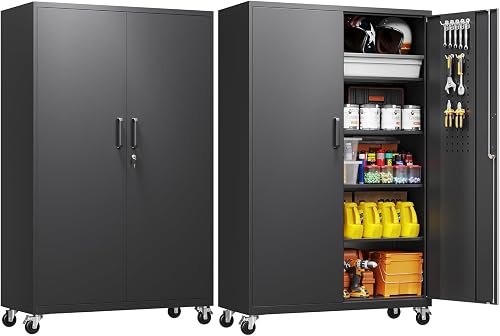 Best for bulky tool storage
Yizosh 71 Inch Rolling Locking Metal Cabinet
 Best for permanent storage zones
Letaya 72 Inch Locking Metal Garage Cabinet
Rolling garage storage cabinet vs stationary: which fits your routine?
Choose wheels for a specific job, such as clearing access behind storage or changing a work zone. Choose a stationary base if you mainly want to open the doors, collect supplies and close them again.
Think through a normal project before buying. If you carry a few hand tools to a bench, a small tool bag may solve that task without moving a tall cabinet.
Rolling storage makes more sense when several groups of supplies need to move together, provided the cabinet's instructions allow the intended load during movement. It can also help when a garage changes between parking, hobbies and seasonal storage.
A fixed cabinet works well beside the bench where you use its contents. You can plan shelf positions, wall anchoring and nearby storage around a location that won't change.
Don't assume wheels make a cabinet suitable for frequent trips across any floor. Our guide to garage cabinets on wheels explains when mobility is useful and when the floor or layout limits it.
Which of these cabinets suits your tools and space?
Pick Yizosh for wider storage, Letaya for a permanent supply zone, or Greenvelly for a narrower rolling option. Their different footprints and bases matter more than their similar heights.
The scores favor fit for rolling storage, but the highest score doesn't make Yizosh the right choice for every garage. Letaya is the better match when movement adds no value.
Yizosh rolling garage storage cabinet: for bulky tool storage
Choose Yizosh when you need width for larger cases and mixed supplies. Its 19.6 x 43.3 x 70.8 in body has 4 adjustable shelves, so you can leave taller spaces where your equipment needs them.
Yizosh specifies a capacity of up to 180 lb per shelf. That makes it worth considering for heavier shelf contents, but you still need to follow separate cabinet and moving load limits.
The cabinet has casters, a key lock with 2 keys and doors that open through 180 degrees. Allow room beside the cabinet if you want to use that full opening range.
Skip it if the route includes tight turns or your parked vehicle leaves little aisle space. A wide cabinet loses its benefit if you have to squeeze past it or cannot fully open its doors.
Before ordering, measure your largest case, including handles and latches. Exterior width doesn't tell you the exact usable opening or shelf clearance.
Letaya stationary garage cabinet: for permanent storage zones
Choose Letaya when your cabinet will stay beside the same bench or wall. It measures 18 x 36 x 72 in and has 5 adjustable shelves, making it useful for dividing smaller containers into separate levels.
Its legs have adjustable feet to help level the cabinet, and the back has pre-holes for wall mounting. Letaya specifies up to 120 lb per shelf and includes a key-operated, 3-point locking system.
Skip it if you regularly need to clear the area behind your storage or move the entire supply cabinet between work zones. Its base has no wheels for routine repositioning.
The extra shelf divisions suit grouped hardware, maintenance supplies and smaller tool cases. Leave enough height to lift containers out without scraping the shelf above.
If you're building a longer storage wall, our guide to choosing a garage cabinet system helps you plan the cabinet alongside benches and other units.
Greenvelly rolling garage storage cabinet: for changing layouts
Choose Greenvelly when you want a narrower cabinet with a removable wheel base. It measures 16 x 32 x 73 in and has 4 adjustable shelves.
Its 4 rubber swivel wheels have locks, and you can remove the wheels for a stationary setup by following its instructions. The cabinet also has a 3-point door lock with 2 keys.
Greenvelly specifies up to 120 lb per shelf. Keep that shelf figure separate from any limit that applies to rolling the cabinet with contents inside.
Skip it if your main storage problem is deep equipment cases. The shallower body takes less floor depth, but you need to confirm that your largest items fit inside with the doors closed.
This is the most suitable choice here if your layout may change and you want both setup options. Removing the wheels is a planned conversion, rather than a step to repeat whenever you park it.
How much space does a cabinet need beyond its footprint?
Measure the parking spot, the open doors and the full moving route. Checking only the wall width misses the clearances that determine whether a cabinet is convenient to use.
Mark the footprint on the floor with removable tape. Open nearby doors and park your vehicle normally, then stand where you would reach into the cabinet.
Include handles and other projections when measuring clearance. For rolling models, check the narrowest doorway and the space needed to turn without striking a vehicle, bench or wall.
Check overhead obstacles along the route, including door tracks and low shelves. Don't plan a move that depends on tilting a tall cabinet to squeeze it underneath something.
Allow room to stand back while removing a large case. A door may open in a narrow aisle even when there isn't enough space to lift the contents out comfortably.
Use our garage cabinet sizes guide to separate exterior dimensions from the usable storage space you need.
How should you compare shelf capacity and usable storage?
Match capacity to your heaviest items and shelf spacing to their shape. A higher load figure won't help if your tool case cannot pass through the opening.
Write down what will go inside before choosing a cabinet. Group heavy tools, tall containers, shallow organizers and bulky cases so you can see where shelf height matters.
Don't multiply a shelf capacity by the number of shelves and assume that gives a safe total cabinet load. The frame, base and casters may have separate limits.
Spread heavy items across a shelf instead of concentrating the load at one edge. Keep the heaviest contents low, which also reduces the height you must lift them.
Leave room to grip containers rather than filling every gap. Deep stacks of small boxes make it harder to retrieve one item without disturbing everything in front.
Our guide to metal cabinet shelf weight capacity explains the limits to check. For a broader comparison of storage types, use the garage storage cabinet buying guide.
What setup should you complete before loading either cabinet?
Assemble, position and secure the empty cabinet before adding tools. All 3 cabinets require assembly, so plan enough clear floor space to lay out parts and work without blocking the garage exit.
Check panels, shelves, hardware and base parts before starting. Address damaged parts or missing hardware before building around them.
Follow the assembly order and keep the frame square as directed. If the instructions call for loose fasteners during alignment, complete that step before final tightening.
Fit every shelf support fully, then check that the doors close and the lock operates without forcing them. A door that rubs can signal an alignment issue worth correcting before loading.
On Letaya, use the adjustable feet to level the cabinet as directed. On a rolling model, confirm that the wheels and their fasteners are installed correctly before standing or moving the cabinet.
Our metal storage cabinet assembly guide covers preparation and common assembly problems. Keep the cabinet's own instructions nearby for model-specific steps.
Do rolling and stationary cabinets need wall anchoring?
Follow the anchoring requirements for the exact cabinet and setup. A wheel lock controls rolling, while a wall attachment helps address tipping; one doesn't replace the other.
Yizosh includes a wall mount anchor, Letaya has rear mounting holes, and Greenvelly supports floor and wall mounting. Those features don't tell you which fasteners suit your garage wall.
Identify the wall construction before choosing hardware. If you're unsure about the attachment point or fasteners, get qualified help rather than guessing.
Plan required anchoring before buying a cabinet for frequent moves. A setup that must remain attached to the wall won't serve as freely movable storage.
Never roll a cabinet while it remains attached, and don't leave required anchoring disconnected after repositioning. Our guide to whether tall metal garage cabinets need anchoring explains the questions to resolve first.
How should you move and care for a rolling cabinet?
Move it only along a clear, suitable route and within its movement instructions. Close the doors, secure loose contents and remove weight whenever the instructions require it.
Sweep away screws, gravel and other debris before moving. Small obstructions can stop a wheel suddenly, so don't force the cabinet past resistance.
Check for slopes, floor joints, cords and thresholds. If the route cannot be crossed safely under the cabinet's instructions, choose another route or keep the storage in place.
Once parked, engage any wheel locks and complete the required securing steps. Open the doors only after the cabinet is positioned for use.
For routine care, wipe away dust and spills with a method suitable for the finish, then dry the surfaces. Don't leave wet tools or damp rags inside, even when the steel has a protective coating.
Inspect accessible fasteners, shelf supports and wheel parts from time to time. Stop moving the cabinet if a caster is damaged or loose, and repair it according to the manufacturer's guidance.
Which organization mistakes waste cabinet space?
Organize around access and lifting, rather than equal shelf gaps. Put frequently used supplies where you can reach them without moving heavy containers first.
Use shallow bins for small parts and label the front of each container. Group items by task so a repair kit or project box can leave the cabinet together.
Don't place heavy cases high just because the upper shelf has open space. Keep lighter, less-used items higher and leave daily tools within comfortable reach.
Avoid storing loose objects where they can shift into a door or fall when it opens. This matters especially when a cabinet is repositioned.
A key lock helps control access but doesn't make every stored substance suitable for the cabinet. Follow separate storage instructions for chemicals, batteries and other materials with special needs.
Our garage cabinet organization guide shows ways to divide shelves into useful zones without filling every surface.
Which garage cabinet should you choose?
Choose the base first, then the cabinet that fits your contents and access space. A rolling garage storage cabinet earns its place when movement solves a recurring problem and the setup allows it.
- Choose Yizosh for bulky tool storage when you have enough width, door clearance and turning space.
- Choose Letaya for a permanent storage zone where separate shelf levels and adjustable feet are more useful than wheels.
- Choose Greenvelly for a narrower rolling cabinet when you may later want to remove the wheels and establish a fixed location.
Before ordering, settle 3 questions: where it will park, how your largest item will fit, and how you will meet its securing instructions. Those answers prevent more buying mistakes than choosing by shelf count alone.
If the cabinet must fit into a larger work area, plan that layout with our guide to choosing a garage cabinet system before committing to a base type.
| Product | Best for | Size (D x W x H) | Shelves | Base | Our score |
|---|---|---|---|---|---|
| Yizosh 71 Inch Rolling Locking Metal Cabinet | bulky tool storage | 19.6 x 43.3 x 70.8 in | 4 adjustable | Casters | 8.5 |
| Letaya 72 Inch Locking Metal Garage Cabinet | permanent storage zones | 18 x 36 x 72 in | 5 adjustable | Legs with adjustable feet | 8.3 |
| Greenvelly 73 Inch Rolling Metal Garage Cabinet | changing garage layouts | 16 x 32 x 73 in | 4 adjustable | 4 swivel wheels with locks | 8.1 |
Frequently asked questions
Are rolling garage cabinets stable?
A rolling cabinet needs a level parking spot, a balanced load and any anchoring required by its instructions; wheel locks help stop rolling but do not prevent tipping. Keep heavy items low, close doors before movement and avoid using a tall cabinet as a support while reaching.
Can a rolling cabinet be used as a stationary cabinet?
Yes, if its instructions permit that setup; Greenvelly has removable wheels, while a cabinet parked on casters still needs its required locks and anchoring. Use the intended base and follow the conversion steps rather than resting the cabinet on loose blocks or adding makeshift supports beneath it.
Do garage cabinets need to be anchored?
Anchor a cabinet when its instructions require it, using the specified attachment points and hardware suited to your wall; neither a fixed base nor locked wheels removes tipping risk. Our guide to anchoring tall metal garage cabinets explains what to check before choosing a location and loading shelves.
Which is better for a small garage, rolling or stationary cabinets?
Choose stationary storage when you have one usable parking spot and no clear route for moving a cabinet; wheels help only when another safe position is available. Measure door swing, vehicle clearance and turning space, since a cabinet that fits against the wall may still block access during use.
Can you put heavy tools in a rolling garage cabinet?
Yes, within all shelf, cabinet and moving load limits specified for that model; a shelf limit does not tell you how much the casters can carry during movement. Spread the load, keep heavy tools low and unload as directed before rolling the cabinet to a different spot.