How to Choose a Garage Cabinet System
Choose garage cabinet systems that fit your stored items, available space and shelf loads. Start with the cabinet type you need most, then add pieces that improve access without crowding the garage.
On this page (11 sections)
- What should a garage cabinet system include?
- How do you measure a garage cabinet layout?
- Which material fits your garage conditions?
- How much shelf capacity do you need?
- Should you buy one matching set or build in stages?
- Which cabinets suit different storage jobs?
- How should you arrange cabinets around a work area?
- How do you set up cabinets without access problems?
- How do you keep the system easy to use?
- What buying mistakes should you avoid?
- Which garage cabinet system should you choose?
Choose garage cabinet systems by matching cabinet types, usable space and shelf strength to what you store. A useful setup gives every group of belongings a home while leaving enough room to park, walk and work.
A system can be a matching set or separate cabinets arranged around your tasks. Start with the contents and layout, then choose the pieces that earn their floor or wall space.
For a broader overview of materials and cabinet styles, see our garage storage cabinets buying guide. This guide focuses on combining those pieces into a setup you can use comfortably.
What should a garage cabinet system include?
A useful garage cabinet system includes only the cabinet types your belongings and routine need. You don't need tall, base and wall cabinets just because they appear together in a matching collection.
Sort what you already have before shopping. Separate items to keep, discard or move elsewhere, then group the rest by task, size and weight.
| Cabinet type | Works well for | Check before choosing |
|---|---|---|
| Tall cabinet | Bulky gear and items that need vertical clearance | Interior height, shelf positions and tipping precautions |
| Base cabinet | Hand tools, supply bins and items used often | Shelf strength, door opening and bending required |
| Wall cabinet | Smaller, lighter supplies above the floor | Wall structure, mounting method and comfortable reach |
| Rolling cabinet | Tools and supplies that move between tasks | Loaded stability, wheel locks and floor condition |
Give each proposed cabinet a clear job, such as gardening supplies or car care tools. If you cannot name its contents, leave that space open until you know what you need.
Separate clean supplies from dirty tools where practical. A shelf full of dusty yard gear is a poor home for cloths you use on a vehicle's finish.
How do you measure a garage cabinet layout?
Measure the cabinet footprint, door clearance and working space in front of it. A cabinet can fit against the wall yet still make the garage difficult to use.
Record wall length, ceiling height and usable floor depth. Mark outlets, switches, pipes, windows and garage door tracks, including the space used by the garage door as it moves.
Use painter's tape to mark cabinet outlines on the floor. Park your vehicle in its usual spot and check access with the car doors open.
Allow room to stand in front of each cabinet and pull out the largest stored bin. Include handles and door movement when you check nearby walls, appliances and other cabinets.
Check exterior and interior dimensions separately. Panel thickness, shelf supports and the door opening can reduce the space available for a rigid toolbox or tote.
Measure your largest belongings rather than estimating from cabinet volume. Our garage cabinet sizes guide explains width, depth and height in more detail.
Also check the delivery route and assembly area. Leave space to lay out panels and build the cabinet without trapping it behind another unit.
Which material fits your garage conditions?
Choose material by moisture exposure, likely bumps, shelf loads and care needs. Material alone does not tell you how much a cabinet can hold or where it can be installed.
Metal cabinets can suit tool storage and work areas, but construction and finish matter. Compare each cabinet's shelf limits and care instructions rather than treating all metal units as equally strong.
The Suncast options below use multi-wall resin panels. Suncast says this construction resists rust and dents, which makes these cabinets worth considering for routine garage storage.
Resin still needs proper support and sensible loading. A rust-resistant cabinet also does not keep damp tools dry, so let wet items dry before closing them away.
Choose an indoor location unless the exact model's instructions allow your intended exposure. A covered patio, an enclosed garage and an open yard put different demands on a cabinet.
Read our metal vs plastic garage cabinets comparison to narrow the material choice. For metal-specific details, see how to choose a metal storage cabinet for your garage.
How much shelf capacity do you need?
Choose shelf limits that cover the actual load on each level, including storage bins. A cabinet's total capacity is not permission to place that whole load on one shelf.
Weigh dense groups such as hardware boxes and tool cases if you are unsure. Several small containers can weigh more than a large bin of light seasonal supplies.
An evenly distributed load spreads weight across the shelf. One heavy object in the center does not load a shelf the same way as several lighter objects spread over its surface.
Keep heavy items low and easy to lift without twisting. Avoid a setup that requires you to lower a loaded toolbox from above shoulder height.
Check shelf spacing as carefully as strength. Removing a shelf may allow tall jugs to fit, but it also removes a storage level for smaller items.
Do not infer a cabinet-top or cabinet-floor load limit from the shelf limit. Our guide to garage cabinet shelf weight capacity explains how to interpret these differences.
Should you buy one matching set or build in stages?
Buy a matching set when every included piece fits a planned job and location. Build in stages when you are still sorting belongings or learning how the garage needs to work.
Matching pieces can simplify the look of a wall, but appearance does not guarantee compatibility. Similar widths do not prove that cabinets can stack, connect or support a shared worktop.
Confirm any intended connection or accessory with the manufacturer. Do not drill cabinets together or bridge them with a loaded surface unless the installation guidance permits that arrangement.
For a staged setup, start with the pile causing the biggest problem. Bulky yard gear may justify a tall cabinet first, while daily hand tools may be better served by a base cabinet.
Use the first cabinet long enough to spot awkward reaches and unused space before adding more. Some remaining items may belong on open shelves instead, as our garage cabinets vs garage shelving guide explains.
Which cabinets suit different storage jobs?
Choose a cabinet for its specific role, then check how it fits the rest of the layout. These 4 resin options cover tall storage, everyday base storage, wall storage and heavier shelf loads.
They illustrate different ways to build a system. Do not assume they form a connected kit or share accessories.
Tall garage cabinet systems for bulky gear
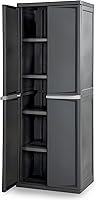
The Suncast 72 Inch Resin Storage Cabinet suits households that need closed storage for lawn gear, hand tools and supplies of different heights. Its 3 adjustable reinforced shelves each hold up to 75 lb.
Choose it when you can use vertical space and want to change shelf spacing as your storage needs shift. It also accepts the compatible BMC3020 add-on shelf.
Skip it if your main problem is heavy tool cases that exceed its shelf limits. A tall shell also does not ensure long-handled tools will fit alongside every shelf, so plan the interior arrangement around your longest item.
The padlockable doors have upper and lower latches. Keep daily supplies in the middle of the cabinet and reserve harder-to-reach areas for lighter, less-used belongings.
Base storage for everyday supplies
The Suncast 9 Cu Ft Resin Base Cabinet suits gardening supplies, hand tools and grouped household gear. It measures 30 in W x 20.25 in D x 36 in H.
Its 2 reinforced shelves each support up to 75 lb with weight evenly distributed. The padlockable doors use upper and lower latches, and the padlock is separate.
Choose it when you want supplies below wall-storage height without filling a tall cabinet. Its 25-inch-wide door opening deserves attention if you store rigid bins that nearly fill the cabinet's width.
Skip it for loads above its shelf limits or a location requiring outdoor use. Use this model indoors, as its instructions require.
Group small items in shallow bins so supplies at the back remain reachable. Do not treat its top as a workbench without confirming that use and the allowed load.
Wall storage for a clear floor
The Suncast 4 Cu Ft Resin Wall Cabinet suits smaller tools and supplies when floor space is scarce. Its dimensions are 30 in W x 12 in D x 30.25 in H.
It has an adjustable, metal-reinforced shelf rated for up to 50 lb and padlock-ready handles. A padlock is not included.
Choose it when you have a suitable mounting surface and can reach the planned shelves comfortably. The shallower depth suits smaller containers better than deep totes.
Skip it if you cannot install it securely or expect to lift heavy equipment overhead. The mounting must support the cabinet and contents, so shelf capacity alone cannot guarantee a safe installation.
Check the reach from your normal standing position, especially above a bench. Store lighter items here and keep dense tool cases lower down.
Base storage for heavier loads
The Suncast 30 Inch Resin Base Cabinet suits heavier tool groups and bulk supplies that need reinforced shelves. Its 2 metal-reinforced shelves each support up to 200 lb with weight evenly distributed.
It has the same exterior dimensions as the lighter-duty base option above, but the higher shelf allowance serves a different load. Choose it because your stored items need that capacity.
A shelf can be removed for taller bottles or jugs. Decide whether that extra height is worth losing a separate storage level.
Skip it when vertical storage or floor clearance matters more than shelf strength. A compact cabinet can become difficult to use if you pack deep shelves with loose items.
Its doors are padlock-ready, with a padlock sold separately. Spread dense contents across the shelf rather than collecting them in one small area.
How should you arrange cabinets around a work area?
Place cabinets near the tasks they support, with heavy and frequently used items within easy reach. Keep direct routes to the house, yard and garage exit clear.
Put gardening supplies near the route outside and car care tools near the vehicle work area. Check each stored product's temperature and ventilation requirements before assigning it a garage shelf.
An ordinary storage cabinet is not a substitute for specialized chemical storage. Follow container labels, keep products in suitable containers and separate materials that should not be stored together.
Do not assume padlock-ready doors make a cabinet childproof or protect against a determined break-in. Use locks as one part of controlling access.
Leave a clear place to set items down while opening bins or sorting tools. For more placement help, see garage cabinet ideas for what to store and where.
How do you set up cabinets without access problems?
Assemble and secure cabinets before loading them, following each unit's instructions. Positioning empty cabinets gives you a chance to correct alignment and clearance problems.
Inspect parts, identify hardware and allow enough space to work. Our metal storage cabinet assembly guide explains useful preparation steps, though resin cabinets can use different connections.
Choose a stable location and follow the instructions for uneven floors. Avoid improvised supports that can shift when the cabinet is loaded or a door is pulled open.
Wall cabinets need hardware suited to the wall structure. Freestanding units may need restraint too; our cabinet anchoring guide explains why standing on the floor does not remove tipping concerns.
Check door movement before adding contents. Load from the bottom upward, spread weight across shelves and stop if a shelf moves out of position or the cabinet shifts.
How do you keep the system easy to use?
Keep shelf assignments, labels and care routines simple. A cabinet stays useful when you can find an item and return it without moving several other things.
Group small supplies in bins by task, leaving handles and labels visible. Avoid stacking everyday items so high that reaching one requires unloading a shelf.
Wipe up spills promptly and clean surfaces as the cabinet instructions allow. Keep grit away from moving parts and avoid forcing a door that has begun to bind.
Check shelf supports, latches, mounting points and restraints during routine cleanup. If something loosens or shifts, unload the affected area before correcting it.
Return wet or dirty tools only after cleaning and drying them. Our garage cabinet organization guide offers more ways to assign shelves and keep groups together.
What buying mistakes should you avoid?
Avoid buying cabinet volume without checking usable access and load limits. A smaller cabinet with the right shelves can solve more problems than a large unit with awkward clearances.
These mistakes are easy to catch before ordering:
- Buying around a matching finish. Decide what each piece will hold before choosing the set.
- Checking only closed-door depth. Leave room to open doors and remove bins with the vehicle parked.
- Confusing exterior size with usable space. Check the door opening and interior clearance for large items.
- Using shelf capacity as a worktop rating. Confirm each surface's allowed use separately.
- Planning dense storage overhead. Keep heavy loads low enough to handle comfortably.
- Assuming accessories fit. Confirm compatibility for shelves, connections and any planned additions.
Allow for installation needs as well as cabinet size. Mounting hardware, tools, restraints and separate padlocks can affect which setup is practical for your space.
Which garage cabinet system should you choose?
Choose garage cabinet systems that solve your largest storage problem first. Use the tall Suncast for varied-height gear, the everyday base model for lighter supply groups, or the reinforced base for heavier shelf loads.
Choose the wall cabinet when clearing the floor matters and you have a suitable mounting location. Leave room for access and add another cabinet only when you can give it a clear job.
Before ordering, write down each cabinet's contents, planned location and shelf loads. Return to our complete garage storage cabinets guide if you still need to compare other cabinet styles.
Frequently asked questions
What should a garage cabinet system include?
A garage cabinet system should include cabinets with a clear job: tall storage for bulky gear, base storage for daily supplies, and wall storage where floor space is tight. You may need only one or two types.
Sort your belongings and measure them before deciding how many cabinets to buy.
Are garage cabinet systems better than separate cabinets?
A coordinated system works well when every included cabinet fits your space and storage needs. Separate cabinets give you more freedom to choose shelf strength, depth and placement for each task.
Buy a set for a suitable layout, rather than accepting unwanted pieces just to get a matching finish.
Should garage cabinets be mounted to the wall?
Wall cabinets need secure mounting, while freestanding cabinets need whatever restraint their instructions require. These are different installation jobs.
Follow the cabinet instructions and choose hardware suited to the wall structure.
A tall cabinet can need anchoring even though it stands on the floor rather than hanging from the wall.
How do I plan garage cabinets on a budget?
Start with one cabinet that solves your biggest storage problem, then add pieces after you know what remains loose or hard to reach. Allow for any mounting hardware, padlocks and assembly tools you need.
Compare usable shelf space and access, since extra cabinet volume is wasted when your belongings cannot fit.