Garage Cabinets vs Garage Shelving: Which Is Better? (November 2026)
For garage cabinets vs shelving, choose cabinets for covered storage and lock options, or shelving for bulky bins and quick access. Use both when small supplies and large gear need different homes.
On this page (11 sections)
- Garage cabinets vs shelving: which works better?
- How do cabinets and shelves compare for access?
- Which storage option keeps dust and clutter down?
- Which is safer for heavy garage items?
- Do garage cabinets offer more security?
- Which takes less room in a garage?
- How should you assemble and place garage storage?
- Can you mix garage cabinets and shelving?
- How do you care for garage cabinets and shelves?
- What mistakes should you avoid before buying?
- What should you choose for your garage?
Choose garage cabinets for covered storage and lock options; choose shelving for bulky bins and quick access. The garage cabinets vs shelving decision starts with what you store and how you move through the garage.
Cabinets suit small supplies you want grouped behind doors. Shelving suits large containers, awkward gear and items you need to spot without opening anything.
Many garages benefit from both, but you don't need to buy a full matching system. Start with the storage problem that matters most, then add another unit only when it has a clear job.


Garage cabinets vs shelving: which works better?
Cabinets work better for concealment and access control, while shelving works better for visible, easy-to-reach storage. Neither type automatically carries more weight or uses less floor space.
| Your main need | Better starting point | What to check |
|---|---|---|
| Small supplies kept out of sight | Cabinet | Shelf spacing and usable interior width |
| Large bins used often | Open shelving | Bin clearance and shelf depth |
| Routine access control | Lockable cabinet | Lock type and key storage |
| Heavy tools or dense supplies | Either | Shelf and total load limits |
| A narrow parking aisle | Either | Depth plus room to retrieve items |
| Different sizes of garage gear | Mixed setup | A clear purpose for each unit |
Don't pay for doors simply to hide a pile you haven't sorted. Cabinets become useful when each shelf has a purpose; otherwise, clutter just moves behind a closed front.
Open shelves need the same planning. Skip them for loose small parts unless you also have suitable bins, trays or organizers.
For the wider range of enclosed options, use our garage storage cabinet buying guide. It explains which cabinet features matter for different kinds of garage storage.
How do cabinets and shelves compare for access?
Open shelving gives faster visual access, while cabinets add a door between you and your supplies. How often you retrieve an item matters more than how tidy either option looks when empty.
Put daily-use gear where you can reach it without shifting other containers. A shelf that requires moving 3 bins to retrieve 1 tool isn't convenient just because it has no doors.
Cabinets make sense for grouped supplies used together, such as a car-cleaning kit or a garden-tool bin. Opening one door can reveal the whole group without leaving it visible all week.
When are garage cabinets easier to use than shelving?
Cabinets are easier when small items need a defined home and adjustable shelf spacing prevents wasted gaps. They're also useful when several people share the garage and some supplies need controlled access.
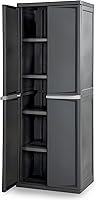
The Yizosh 71 Inch Locking Metal Garage Cabinet has 5 adjustable shelves, a key lock and 2 keys. Its tall layout suits a wall where you want several storage levels within one enclosed unit.
Choose it for mixed-height tool cases and supplies that can share an enclosed space. Adjust shelf positions around the items you actually have, leaving room to grip handles and lift containers out.
Skip it if you need low storage beneath an existing wall fixture or if most of your gear exceeds the door opening. A tall cabinet also shouldn't become an excuse to place heavy tools above a comfortable lifting height.
When is open shelving more convenient?
Open shelving is more convenient for large bins and frequent retrieval. It also lets you spot an empty container or misplaced item before starting a job.
Measure the full container, including its lid, handles and any bulging sides. Allow enough space above it to lift and pull without scraping the shelf above.
Skip open shelving for supplies that need controlled access unless you have another suitable storage arrangement. Visibility and easy reach are benefits only when everyone who can reach the contents should have access.
Which storage option keeps dust and clutter down?
Cabinets reduce direct dust exposure and hide mixed supplies, but they don't replace covered containers or regular cleaning. Open shelves leave contents exposed and work best with a simple bin system.
A closed door isn't an airtight seal. Keep dust-sensitive items in suitable containers, especially near woodworking, sanding or other dusty work.
For open shelves, label bins on the face you can see from the aisle. Clear labels are more useful than matching colors if you can't tell which container holds the supplies you need.
Avoid packing either option so tightly that removing one item disturbs everything around it. Leave a small return space for tools waiting to go back into their assigned bin.
Our garage cabinet ideas can help you assign storage by task. Use the garage cabinet organization guide to divide shelves into groups you can keep in order.
Which is safer for heavy garage items?
The exact load limits decide, not whether the unit has doors or a metal frame. Check the individual shelf limit and any total-unit limit before loading.
The Yizosh shelves are rated for up to 180 lb each. That figure doesn't guarantee the cabinet's total capacity or mean every heavy object is suitable for any position.
Weight distribution matters because a dense tool case places a different load on a shelf than several lighter containers spread across it. Don't add shelf ratings together unless the instructions allow that total.
The Suncast 30 Inch Resin Base Cabinet has 2 metal-reinforced shelves rated for up to 200 lb each with evenly distributed weight. It suits heavier tools when you want enclosed storage at a low height.
Choose this Suncast for heavy items that fit its interior and can be spread across the shelves as directed. Removing a shelf can make room for taller containers, though it also removes a level for separating supplies.
Skip it if you need many shallow levels for small parts or more vertical storage within the same floor footprint. Don't assume its shelf strength makes the top a workbench or permits stacking another cabinet above it.
Keep the heaviest items low and avoid loading a shelf that bends, shifts or has damaged supports. Our garage cabinet weight-capacity guide explains how to read shelf limits before arranging dense loads.
Do garage cabinets offer more security?
A cabinet lock controls routine access, while open shelving leaves contents within reach. Neither a key lock nor a padlock-ready handle makes a general storage cabinet theft-proof.
The Yizosh includes its key lock; both Suncast cabinets require a separate padlock if you want to lock their doors. Decide who needs access, and keep spare keys somewhere other than beside the cabinet.
A locked cabinet can help separate household supplies from shared garage gear. It still needs to suit the contents, and a general cabinet isn't a substitute for storage required for flammable or other hazardous materials.
Keep chemicals in their original labeled containers and follow their storage directions. Don't group incompatible products together simply because they fit behind the same door.
Read our guide to locking storage cabinets if access control is a main reason for choosing doors. Choose the storage method first, then use the lock as one part of that plan.
Which takes less room in a garage?
Compare working clearance as well as footprint. A unit that fits against the wall can still block parking, door opening or the path used to carry bins outside.
The Yizosh measures 31.5 in wide, 15.7 in deep and 71 in high. Its doors can open 180 degrees, but nearby walls and parked vehicles may restrict that movement.
Both Suncast base cabinets measure 30 in wide, 20.25 in deep and 36 in high. Their lower profile leaves wall space above, while their greater depth extends farther into the parking area.
Open shelving avoids cabinet-door swing, but you still need room to pull out a container. Deep shelves can also hide small items at the back unless you use bins that bring them forward together.
Tape the footprint on the floor with the vehicle parked normally. Check car-door clearance, walking space and access to outlets, then mark how far cabinet doors or removed bins will project.
Use our garage cabinet size guide to compare exterior measurements with usable storage. Door openings and interior dimensions matter when a tool case fits the footprint but won't pass through the front.
How should you assemble and place garage storage?
Assemble the unit fully, position it on a suitable surface and follow its anchoring instructions before loading. Doors, shelf supports and fasteners need to work correctly while the cabinet is still empty.
The Yizosh arrives for assembly and includes a wall mount anchor. Both Suncast cabinets also require assembly with minimal tools.
Leave enough floor space to lay out parts without leaning panels against a vehicle. Follow the assembly order rather than loading completed shelves while the rest of the frame is unfinished.
Garage floors may slope toward the door, so check for rocking and poor door alignment at the final position. Use only leveling methods allowed by the unit's instructions.
Open shelving may also require anchoring, even when it stands on its own. Follow the attachment requirements for the unit and wall type; our cabinet anchoring guide explains the planning involved.
Load gradually after setup, starting with heavier items on lower levels. Recheck that the frame stays steady and doors close without rubbing or needing force.
Can you mix garage cabinets and shelving?
Yes, a mixed setup works well when each type has a separate job. Use cabinets for smaller grouped supplies and shelving for bulky containers you remove often.
The Suncast 9 Cu Ft Resin Base Cabinet suits everyday hand tools and gardening supplies stored indoors. Its 2 reinforced shelves hold up to 75 lb each with evenly distributed weight.
Choose this model when you want low enclosed storage without the higher shelf capacity of the other Suncast. Skip it for loads above its limits or when a tall cabinet would better use a narrow section of wall.
For this model, choose an indoor location and follow its indoor-use instructions. A resin body alone doesn't mean the whole cabinet suits an exposed outdoor spot.
Place open shelves beside the cabinet for large seasonal bins. Any shelving above it should have its own approved support rather than resting on the cabinet unless the instructions permit that arrangement.
Leave frequently used gear closest to the working area. Seasonal storage can sit farther away, provided retrieving it doesn't require blocking your normal exit route.
How do you care for garage cabinets and shelves?
Keep storage clean, dry and within its load limits. Closed doors reduce exposure, but wet tools and damp containers can bring moisture inside.
Let gear dry before putting it away, and wipe up spills promptly. Clean surfaces with products suitable for their material rather than assuming a strong solvent is safe.
Suncast says its resin panels resist rust and dents; Yizosh uses a powder-coated steel finish. Protect metal finishes from scratches, and remember that hinges, fasteners and reinforced shelves also need inspection.
During seasonal cleanouts, check shelf supports, door alignment and any anchoring hardware. Unload a section before changing its shelf height or correcting a loose connection.
Keep storage tops clear unless their intended use and load limit allow otherwise. Loose items piled overhead are harder to retrieve and easy to forget during routine checks.
What mistakes should you avoid before buying?
Don't choose by exterior size, appearance or shelf strength alone. The right unit must fit both the stored items and the way you retrieve them.
- Buying before sorting: Remove empty packaging and unwanted gear, then measure what remains.
- Ignoring openings: Check that wide cases pass through cabinet doors and between shelf supports.
- Using every inch: Leave room for hands, handles and the movement needed to remove a bin.
- Hiding frequently used gear: Keep daily supplies at a comfortable reach instead of behind several other items.
- Assuming material decides capacity: Compare the exact shelf limits rather than choosing steel or resin by appearance.
- Planning around a clear garage: Measure with cars, ladders and other permanent items in their usual places.
Before ordering several units, sketch where each storage group will go. One well-placed cabinet and a shelf unit may serve you better than a full wall of doors with no space for large bins.
What should you choose for your garage?
The final garage cabinets vs shelving decision should follow your hardest storage need. Pick the type that makes your most-used items easy to retrieve while keeping the parking and walking areas clear.
Choose the Yizosh if you need tall enclosed storage with adjustable levels and a supplied key lock. Choose the Suncast 9 Cu Ft cabinet for everyday indoor supplies, or the Suncast 30 Inch cabinet for heavier shelf loads.
Choose open shelving if bulky bins and fast visual access drive the decision. Use a mixed setup when small supplies need doors but larger gear needs open space.
Measure your largest container and your narrowest access point before buying. For several units along one wall, see how to choose a garage cabinet system to plan the layout around those measurements.
Frequently asked questions
Are garage cabinets better than shelving?
Garage cabinets are better for covered storage and controlling routine access, while shelving suits bulky bins and gear you grab often. Choose cabinets when doors solve a clear need, such as hiding small supplies; choose shelving when seeing and removing large items matters more than keeping them concealed.
Do garage cabinets hold more than shelves?
Neither type automatically holds more; compare the exact unit's usable dimensions, individual shelf limits and total load limit, then check whether your containers fit through the opening. A high weight limit won't help if the shelf is too shallow, and a large cabinet may still have shelves unsuited to concentrated loads.
Should I choose metal or resin garage cabinets?
Choose by shelf layout, load limits and care needs before choosing by material; the steel Yizosh suits tall, adjustable storage, while these resin Suncast cabinets suit lower storage. Resin bodies don't rust, but reinforced shelves and hardware still need care; metal finishes also need protection from scratches and standing moisture.
Can I mix garage cabinets and shelving?
Yes, mixing cabinets and shelving gives small supplies a covered home while leaving bulky bins easy to reach. Assign each type a job before buying, and keep heavy items low; leave room for doors and bin removal, and follow each unit's assembly, loading and anchoring instructions.