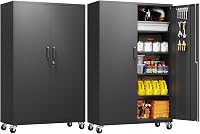
Best Garage Cabinets on Casters: How to Choose
Garage cabinets on casters are worth it when you need to clear floor space or move storage to the job. Look for four casters with at least two locks, a steel frame rated for your heaviest shelf load, and a cabinet width that still fits your widest walkway.
On this page (7 sections)
- What makes a garage cabinet suited to casters?
- How much shelf load should you plan for?
- Which cabinet fits which garage job?
- How should you measure before you buy a rolling cabinet?
- What to check on the wheels and brakes?
- How do you keep a steel rolling cabinet in good shape?
- What are the best garage cabinets on casters for most buyers?
Garage cabinets on casters make sense when the floor is shared space: a parking bay by day, a work zone on weekends. You roll the cabinet to the bench for a job, then push it back against the wall.
The trade is simple. Casters buy you movement, and in return you give up a little stability and some shelf load compared with a fixed cabinet bolted to the wall.
This guide shows how to weigh that trade before you buy.
Start by deciding what the cabinet has to do. A rolling tool store, a cleaning station and an overflow pantry have different needs.
Once you know the job, the specs are easier to judge.
What makes a garage cabinet suited to casters?
A cabinet works on casters when four wheels, a steel frame and locked brakes keep it steady while you load it. A tall cabinet on small wheels can flex when a heavy door swings open.
Three checks decide it. First, the wheel count and brake count.
Second, the shelf rating against the items you plan to stack. Third, the cabinet's height-to-width ratio, since a narrow tall unit tips more easily than a squat one.
Casters also raise the cabinet. A 71 to 73 in cabinet on wheels needs clearance above for the doors to open without hitting a shelf or garage door track.
Measure that headroom before delivery.
Floor surface matters too. Rubber wheels run quietly and grip smooth concrete, and the cabinets here all use rubber.
A cracked or sloped slab is the bigger problem, because a wheeled cabinet will roll downhill unless a brake holds it.
Pick casters only when movement is a real need. If the cabinet stays in one spot for years, a fixed cabinet gives you more shelf load for the same money.
Four wheels, two brakes and one honest question
Ask how many wheels lock. Greenvelly locks all four rubber wheels, so the cabinet stays put when filled.
LISSIMO uses four lockable rubber casters. Eltean fits four wheels, two of them swivel with a brake.
Two brakes on the front pair is usually enough on flat concrete. All four locked is better on a slope or where kids and bikes pass close by.
Check the brake type too, since a pedal brake is easier to set with full hands than a small lever.
The other question is whether you want to keep the wheels at all. All three cabinets here let you leave them off.
That gives you a fallback if the cabinet ends up in a fixed spot.
When a fixed cabinet beats a rolling one
Casters are the wrong choice when the cabinet never moves and holds very heavy items. A wall-hung or floor-fixed steel cabinet spreads load through its frame and mounting points rather than through four small wheel contacts.
Fixed cabinets also free up floor area underneath and let you build a run of units tight against a wall. If you want a full run of storage, read our guide to garage cabinet systems before you buy a single rolling unit.
One middle path is a rolling cabinet that also takes wall anchors. Eltean provides six pre-drilled holes in the back and expansion screws so you can fix the cabinet in place and still keep the option to move it later.
Choose a fixed cabinet when the spot is settled and the load is heavy. Keep casters for the unit that follows you around the garage.
How much shelf load should you plan for?
Plan for the heaviest single shelf, not the total cabinet load. A shelf rated 120 lb holds a stack of hand tools or paint cans without bowing; 180 lb gives you room for heavier power tools.
The three cabinets here split into two groups. Greenvelly rates each of its four shelves at up to 120 lb.
LISSIMO and Eltean both rate their shelves at 180 lb, though LISSIMO has two adjustable shelves and Eltean has four.
Shelf count changes how you organize more than the load figure does. Four adjustable shelves let you set one bay for tall items like a jack or a trimmer and the rest for bins.
Two shelves leave more open height per bay.
Add the cabinet's own weight to your plan. Greenvelly weighs about 90 lb, LISSIMO about 86 lb and Eltean about 92 lb.
A loaded cabinet on casters is a heavy thing to stop on a slope, which is why brake count matters.
Treat the shelf rating as a ceiling, not a target. Leave a margin for the toolbox you add later and the odd heavy box you shove in on moving day.
Matching shelves to what you store
Set the shelf spacing around your tallest item first, then fill the gaps. A 73 in cabinet has enough height for one tall bay plus three or four short ones.
Wide bins suit shelves set close together. Tall tools, jerry cans and folded ladders need a bay with the shelf removed or dropped low.
That is why adjustable shelves earn their place on a rolling cabinet.
Keep the loaded cabinet under the shelf rating on every level. One overloaded shelf is enough to bow a steel panel and stop the doors closing cleanly.
Which cabinet fits which garage job?
The best cabinet for most garages is the Eltean 71", because its three-point lock and four adjustable shelves cover tools and bulky gear in one unit. The other two suit narrower jobs.
Our score weighs specs, features and buyer feedback against what you're shopping for. It does not replace your own measurements.
See the full field in our best garage cabinets roundup.
Eltean 71": best for locking tools away
Eltean builds this cabinet around security and flexible shelving. The three-point metal locking system comes with two keys, and the magnetic doors close on steel handles.
Ventilation holes keep air moving inside so tools do not sit in stale air.
Four adjustable shelves each hold up to 180 lb. That lets you set one tall bay for a tool case and stack bins on the rest.
The cabinet stands 15.41 in deep by 31.52 in wide by 71 in tall, so it fits a wall run without eating much floor.
The wheels are two swivel casters with brakes plus two fixed wheels. If you would rather not use them, the six pre-drilled holes and expansion screws in the back let you mount the cabinet to the wall.
Pick it if the garage holds tools you want locked up and you want shelf flexibility. Skip it if you need a drawer for small parts; the LISSIMO has one.
Greenvelly 73": best for converting to a fixed cabinet
Greenvelly's pitch is the wheel that disappears. The four rubber wheels lock when parked, and they unscrew so the cabinet becomes a regular floor-standing unit.
That suits a garage where the layout might change in a year.
The cold-rolled steel body has a rust-resistant, wear-resistant finish, and each of the four shelves holds up to 120 lb. A three-point locking system and two keys protect the contents.
The cabinet is 16 in deep by 32 in wide by 73 in tall and weighs about 90 lb.
The 120 lb shelf rating is the lowest here. That is fine for hand tools, paint, cleaning supplies and boxed goods.
It is not the cabinet for a shelf full of engine blocks or dense metal stock.
Choose it when you want the option to move now and fix later. Skip it if you need the highest shelf load; the Eltean and LISSIMO both rate 180 lb.
LISSIMO 73": best for mixed small and large items
LISSIMO adds a locking center drawer to the usual door-and-shelf layout. Small items like screws, fuses, chargers and measuring tools go in the drawer, and bulky gear stays on the shelves.
The cabinet is 15.7 in deep by 31.5 in wide by 72.8 in tall and weighs about 86 lb. Two adjustable shelves hold up to 180 lb each.
The powder-coated finish resists scratches and rust, and the doors lock with two keys.
Its four heavy-duty rubber casters lock and can be removed for a fixed install. The cabinet runs on five compartments, so you can separate tool groups by bay.
Pick it if your garage mixes small parts with big gear. Skip it if you need four separate shelves; the Eltean offers more shelves and the same 180 lb rating.
How should you measure before you buy a rolling cabinet?
Measure the doorway, the parking spot and the headroom before you order. A cabinet that clears the garage door but cannot turn the corner will not fit.
Work through four numbers:
- The cabinet's width and depth against the narrowest doorway and the turn into the garage.
- The floor outline at each position the cabinet will use, plus the walking gap beside it.
- Headroom above the cabinet for the doors to open and for the top shelf to be loaded.
- The gap you need to stand in front and reach the back of the shelves.
The three cabinets here are about 31.5 to 32 in wide. Most single garage doors clear that, but the turn from the driveway into the bay is often tighter than the door itself.
Allow for the wheels when you measure height. A cabinet on casters sits a few inches taller than the same cabinet flat on the floor, and the door swing needs clear space above.
Measure twice, order once. Tape the outline on the floor and roll a box of similar size to each spot.
It takes ten minutes and saves a return.
Parking spots that still leave a walkway
A cabinet parked beside a car needs a gap wide enough to open the doors and stand in front. Pull the car in and out with the cabinet in place before you load it.
If the cabinet will sit in front of shelving or a workbench, leave a clear route to push it aside. A 31.5 in wide cabinet plus the swing of its doors takes more room than its footprint suggests.
Keep a walking gap between the cabinet and the wall opposite. You need space to stand and reach the back of a 15.7 to 16 in deep cabinet without stepping sideways.
The space above and behind the cabinet
Check the garage door track. A 71 to 73 in cabinet on wheels is tall, and the open door needs clearance above it.
A cabinet parked under the track may block the door or the top shelf.
Check the wall behind too. A cabinet pushed flat against the wall traps dust and makes the back shelf hard to reach.
Leave a small gap so you can pull it forward when needed.
Clear the swing zone before you park the cabinet. Doors and the garage door all need room that the cabinet's footprint does not show.
What to check on the wheels and brakes?
Look for four rubber casters, at least two brakes and a stated load rating. Rubber runs quietly on concrete and grips better than hard plastic, and a locked brake stops the cabinet drifting.
The wheel count is not the whole story. A cabinet with two swivel and two fixed wheels turns more predictably than one with four swivels, though four swivels let you slide it sideways into a tight gap.
Eltean uses two swivel wheels with brakes plus two fixed wheels.
Brake type matters in daily use. A pedal brake you can set with your foot is easier than a lever when your hands are full of tools.
Check that the brakes hold when the cabinet is loaded, not just empty.
Removable casters add value. Greenvelly, LISSIMO and Eltean all let you take the wheels off.
That means a wheel failure does not scrap the cabinet, and a change of plan does not force a new purchase.
Pick a cabinet whose brakes match your floor. All-wheel locking is better on a slope; two braked wheels on flat concrete is fine.
Wheels on rough or sloped concrete
A wheeled cabinet on a cracked slab will rock and catch. Sweep the route first and fill any wide cracks before you load the cabinet.
On a slope, lock every wheel you can. A cabinet with two brakes can still pivot on its free wheels.
If the slope is steep, park the cabinet against a wall and use the wall-mount option if the cabinet has one.
Avoid rolling a loaded cabinet over a lip or drain grate. The wheels can catch and the cabinet can tip.
Move the load in stages if the route is rough.
Never move a full cabinet with the brakes off on a slope. Empty the shelves and move it in short pushes.
How do you keep a steel rolling cabinet in good shape?
Steel cabinets on casters last when you keep the wheels clean and the load balanced. Dust and grit in a caster bearing is the most common reason a rolling cabinet stops rolling smoothly.
Wipe the caster forks and wheels every few months with a dry cloth. Hair, sawdust and grit collect there and make the wheels drag.
A dragging wheel puts more strain on the cabinet frame when you push it.
Keep weight low and spread across shelves. A top-heavy cabinet wobbles more on its wheels.
Put dense items like toolboxes and paint on the lower shelves and light items up top.
Check the brakes and the door locks now and then. A three-point lock needs the doors to sit square, so do not overload the shelves and bow the frame.
Treat the wheels as the weak point. Clean casters and a balanced load keep the cabinet rolling and standing straight.
Rust, moisture and fixed installs
Garage air carries moisture, so wipe up spills and keep wet gear out of the cabinet. The finishes here are powder-coated and rust-resistant, but a wet mop left inside can still start a rust spot.
Leave the doors open for an hour after storing damp tools. Eltean builds ventilation holes into the cabinet for exactly this reason.
Airflow helps tools dry and keeps odors down.
Take the wheels off when the cabinet has found its permanent spot. That removes the wobble and lets the cabinet sit flat on the floor.
If the cabinet has wall-mount holes, use them for extra stability; Eltean's six pre-drilled holes and expansion screws are the simplest option of the three.
Fix the cabinet once the layout stops changing. Until then, keep the casters on and use the brakes.
What are the best garage cabinets on casters for most buyers?
The Eltean 71" is the pick for most garages, because four adjustable shelves and a three-point lock cover tools and bulky gear in one cabinet. Its 180 lb shelf rating and two braked swivel wheels suit a working garage that moves storage around.
Choose the Greenvelly 73" if you want a cabinet that can shed its wheels and become a fixed unit, and 120 lb shelves are enough for what you store. Choose the LISSIMO 73" if a locking center drawer for small parts matters more than a fourth shelf.
For the widest field of rolling options, browse our best rolling garage cabinet roundup. If your garage needs fixed storage more than movable storage, read how to choose a metal storage cabinet for your garage and build a system that stays put.
Either way, measure the route and the parking spot first. A garage cabinet on casters only earns its wheels when it fits the space it has to move through.
Frequently asked questions
Are garage cabinets on casters stable enough to hold tools?
Yes, if the casters lock and the cabinet sits level. Look for at least two locking wheels and a load rating per shelf that covers your heaviest items.
A cabinet with brakes set on a flat concrete floor stays put during normal use.
How much weight can a rolling garage cabinet hold?
It depends on the cabinet. The shelves in the three cabinets here are rated at 120 to 180 lb each.
The cabinet frame, the caster rating and your floor all matter, so keep the total load within the figure the maker states.
Can I remove the wheels from a rolling garage cabinet?
On many models, yes. Greenvelly and LISSIMO both say their casters can be removed to leave a freestanding cabinet.
Eltean offers the same choice and adds six pre-drilled holes for wall mounting instead.
Do rolling cabinets fit through a standard garage door?
Check the cabinet width against your door and walkway before buying. The three cabinets here are about 31.5 to 32 in wide.
A cabinet under 32 in wide clears most single garage doors, but measure the turn into the room as well.
Should I buy a rolling cabinet or a fixed one?
Pick casters if you need to move storage to the work area or clear the floor often. Pick a fixed cabinet or a wall-mounted system if the spot never changes and you want the heaviest shelf loads without wheel flex.